Gas Mask & Traffic Signal
Garrett Morgan invented a safety hood (gas mask) that saved lives in a 1916 tunnel disaster and later patented a three-position traffic signal that made roads safer for everyone.
View Teaching Bundle →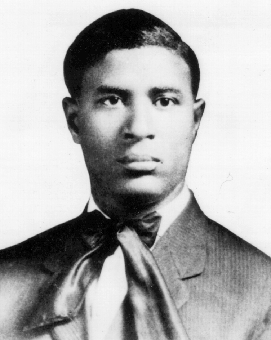
What Is the Gas Mask & Traffic Signal?
Garrett Morgan invented a safety hood (gas mask) that saved lives in a 1916 tunnel disaster and later patented a three-position traffic signal that made roads safer for everyone.
Imagine being trapped deep underground with smoke and poisonous gases filling the air, and no way out. That was the nightmare workers faced on July 24, 1916, when an explosion rocked a tunnel beneath Lake Erie in Cleveland, Ohio. But then — help arrived in the form of Garrett Morgan and his remarkable invention: the Safety Hood and Smoke Protector. Garrett Morgan was born in 1877 in Paris, Kentucky, the son of formerly enslaved parents. He moved to Cleveland as a young man with almost no formal education, determined to build a better life through hard work and creativity. And creative he was! Morgan noticed that firefighters and rescue workers were being injured or killed by smoke and toxic fumes. So he invented a safety hood — an important early design of the gas mask — and patented it in 1914. When disaster struck that tunnel in 1916, Morgan pulled on his invention and led the rescue himself, descending multiple times into the smoke-filled tunnel to bring workers out. His invention worked in the most dangerous real-world test possible. His safety hood design was so significant that it influenced breathing protection equipment used in World War I to protect soldiers from chemical weapons. But Morgan was not done inventing. In 1923 he looked at busy city intersections and saw a problem: two-position traffic signals (just stop and go) were causing terrible accidents. His solution was brilliant — he added a third position, a caution or 'all stop' phase, giving drivers and pedestrians time to clear the intersection before traffic moved again. He sold this patent to General Electric for $40,000. It is important to know that traffic signals already existed before Morgan — his specific contribution was the three-position design that added this crucial pause. That innovation influenced how engineers designed traffic control systems for years to come. Garrett Morgan's genius made the world both safer and more organized.
Meet the Inventor: Garrett Morgan
Garrett Augustus Morgan was born on March 4, 1877, in Paris, Kentucky, the seventh of eleven children born to Sydney and Elizabeth Morgan. His parents had been enslaved, and after emancipation they worked as farmers. Garrett received only a sixth-grade education before moving north to Cincinnati and then Cleveland, Ohio, in search of opportunity. In Cleveland, Morgan taught himself to repair sewing machines and eventually opened his own tailoring shop. He was a natural problem-solver who refused to accept that things could not be improved. His curiosity led him to invent a hair-straightening cream around 1909, which he then marketed through his own company — an early example of his business savvy. Morgan also founded and published the Cleveland Call, a newspaper serving Cleveland's Black community, showing that his talents extended well beyond the workshop. Despite facing significant racial prejudice — his safety hood's success was sometimes hidden at demonstrations because some buyers refused to purchase equipment from a Black inventor — Morgan persisted. He was honored by his community and celebrated toward the end of his life. He died on July 27, 1963, in Cleveland at age 86, leaving behind a legacy of life-saving innovation.
How It Works
Garrett Morgan's Safety Hood and Smoke Protector worked by filtering the air a person breathed. The hood covered the entire head and connected to a tube that hung down to the floor. Why the floor? Because smoke and toxic gases rise, while cleaner, cooler air stays low near the ground. The tube pulled in that cleaner air from below the smoke layer. Inside the tube was a wet sponge or filter that helped trap particles and cool the air before it reached the wearer's lungs. The hood used simple physics — air pressure and gravity — to give rescue workers a protective bubble of breathable air. Other breathing devices existed before Morgan's, but his folded hood design was a practical advance that made it more useful for rescue workers entering burning buildings and smoke-filled spaces. His traffic signal innovation used mechanical timing to control when each direction of traffic moved, adding a crucial pause phase — a third position — so cars from all directions stopped before pedestrians crossed. This simple addition — a sequenced all-stop — addressed a gap in earlier two-position signals and influenced traffic control engineering. Both inventions used elegant engineering to solve real safety problems.
Timeline
Watch and Learn
Did You Know?
Hidden Identity
When Morgan demonstrated his safety hood at trade shows, he sometimes had a non-Black assistant wear it — or wore a disguise himself — to hide that a Black inventor had created it, because some customers refused to buy from Black entrepreneurs. After the Lake Erie tunnel rescue made his identity widely known, Southern buyers cancelled orders.
A Newspaper Publisher Too
Morgan founded and ran the Cleveland Call newspaper, one of the most important Black-owned newspapers in Ohio, showing he was as gifted at communication as he was at engineering.
Only a Sixth-Grade Education
Morgan attended school only through sixth grade, yet he became one of the most important inventors of the early 20th century — proof that curiosity and persistence matter as much as formal schooling.
A Specific and Important Innovation
Traffic signals existed before Morgan, and other inventors also worked on traffic control technology. Morgan's specific contribution was the three-position signal — adding an 'all stop' phase that cleared the intersection before any direction of traffic moved.
The Three-Position Signal's Legacy
Morgan's three-position signal concept — stop, caution/all-stop, and go — was an important step in the evolution of traffic control. Today's three-color traffic lights reflect a similar logic of giving drivers advance warning before a full stop or start.
STEM Connection
Garrett Morgan's inventions connect to several important STEM concepts students explore in school. The safety hood demonstrates gas behavior and air quality. Toxic gases like carbon monoxide are less dense than cool air, which is why they rise — Morgan's tube captured the denser, cleaner air near the floor. This is the same principle behind why smoke detectors are placed near ceilings. The traffic signal is a masterpiece of systems engineering and sequencing. Engineers must design systems where multiple parts work together in a timed order — exactly what computer programs and assembly lines do. The traffic signal's third-phase 'all stop' is an early example of a safety interlock, a design feature that prevents two incompatible actions from happening at the same time. Modern traffic engineers build on this same concept today. Both inventions also connect to human factors engineering — designing tools around the real needs and limitations of the human body. Morgan watched how people actually moved through dangerous environments and designed accordingly.
Related Inventions
Other Black inventions and innovations that changed the world.
Want to teach this invention? We've done the work for you.
Gas Mask & Traffic Signal Complete Teaching Bundle
Lesson Plan
Comprehensive lesson plan covering the invention, the inventor, how it works, and its lasting impact on everyday life.
Student Workbook
Interactive workbook with reading passages, inventor biography, STEM activities, design challenges, and a quiz.
Flashcard Set
40 cards covering vocabulary, key facts, inventor details, how it works, and review challenges.
Instant digital download · Printable PDF · Grades 3–8 · STEM + History
Here's a peek inside...
📖 Lesson Plan
📝 Student Workbook
Read the passage about Garrett Morgan and the Gas Mask & Traffic Signal, then answer the questions below.
🃏 Flashcard Set - Click to Flip!
Click the card to flip it
Get a Free Sample
Try before you buy! Enter your email to receive a free sampler with flashcards, activities, and a lesson plan excerpt. No spam, just history.