Black Power Movement
A political movement that emphasized racial pride, self-determination, and the creation of Black political and cultural institutions, shifting the civil rights struggle toward empowerment.
View Teaching Bundle →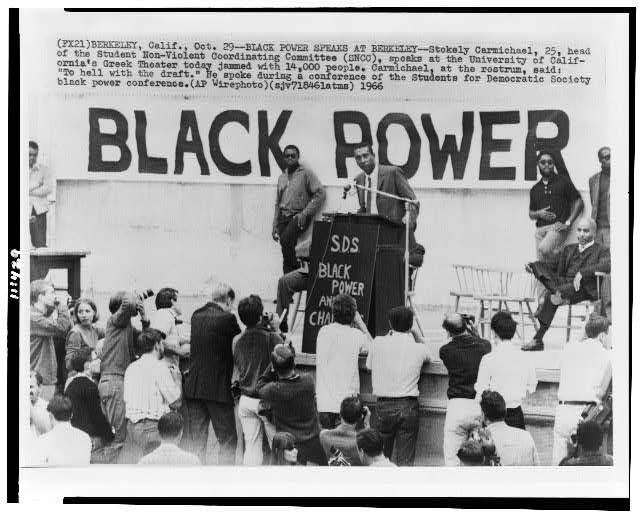
What Was the Black Power Movement?
A political movement that emphasized racial pride, self-determination, and the creation of Black political and cultural institutions, shifting the civil rights struggle toward empowerment.
The Black Power Movement was a broad ideological and cultural movement that emerged in the mid-1960s, representing a significant shift in how many African Americans thought about the struggle for equality. Rather than focusing exclusively on legal integration and nonviolent protest, the Black Power Movement emphasized Black pride, Black cultural identity, economic self-sufficiency, and political self-determination. The movement was not a single organization but a powerful idea that inspired activists, artists, athletes, scholars, and communities across the United States. The phrase 'Black Power' was famously invoked by Stokely Carmichael at a rally in Greenwood, Mississippi, in June 1966, crystallizing a feeling that had been building for years. The movement drew on the legacy of earlier thinkers like Marcus Garvey and Malcolm X, who had long argued that Black Americans needed to define and control their own future. Its cultural wing, the Black Arts Movement, produced poets, novelists, playwrights, and musicians who celebrated Black identity in their work. At the 1968 Olympics in Mexico City, sprinters Tommie Smith and John Carlos raised their fists on the medal podium in one of history's most iconic political gestures. On campuses, Black students demanded and won the creation of Black Studies departments that brought African American history and culture into the formal curriculum. Angela Davis emerged as a prominent scholar and activist whose work connected questions of race, gender, and justice. The Black Power Movement left a lasting cultural and intellectual legacy, shaping how Black Americans talked about identity, culture, community, and power for generations.
Founding Story
The phrase that defined a generation was spoken on a warm June evening in 1966 on a stretch of Mississippi highway. Stokely Carmichael, chairman of the Student Nonviolent Coordinating Committee (SNCC), had just been arrested for the twenty-seventh time. The occasion was the March Against Fear — a 220-mile walk from Memphis, Tennessee, to Jackson, Mississippi, begun by activist James Meredith, who had been shot on the second day of his march and hospitalized. Civil rights leaders including Martin Luther King Jr. and Carmichael continued the march in his place. When Carmichael stood up at a rally in Greenwood, Mississippi, and called out 'We want Black Power!' the crowd responded with thunderous agreement. Carmichael later explained that he had been building toward this language for years. The idea was not new — it drew deeply on the work of Malcolm X, Marcus Garvey's Universal Negro Improvement Association, and a long tradition of Black nationalist thought. But in that moment in Greenwood, the phrase caught fire. Within weeks, it was on the front page of every major newspaper in the country, debated in pulpits and living rooms from coast to coast. What had been building as an undercurrent in civil rights organizing suddenly had a name.
Watch and Learn
Related Organizations
Other organizations and movements connected to this story.
1966–1982
Black Panther Party
Founded by Huey P. Newton and Bobby Seale in Oakland, California, the Black Panther Party fought for Black liberation through community programs, armed self-defense, and political activism.
1960–1970s
Student Nonviolent Coordinating Committee
A youth-led civil rights organization that organized sit-ins, voter registration drives, and Freedom Rides, giving young people a powerful voice in the fight for equality.
1930–Present
Nation of Islam
A religious and political organization that promoted Black self-reliance, discipline, and pride, most famously led by Elijah Muhammad and championed by Malcolm X.
Want to teach this organization? We've done the work for you.
Black Power Movement Complete Teaching Bundle
Lesson Plan
Comprehensive lesson plan covering the organization's founding, mission, key leaders, and lasting impact.
Student Workbook
Interactive workbook with reading passages, timeline activities, leadership analysis, and a quiz.
Flashcard Set
40 cards covering vocabulary, key facts, leaders, achievements, and review challenges.
Instant digital download · Printable PDF · Grades 4–8 · Verified accurate
Here's a peek inside...
📖 Lesson Plan
📝 Student Workbook
Read the passage about the Black Power Movement and answer the questions below.
Get a Free Sample
Try before you buy! Enter your email to receive a free sampler with flashcards, activities, and a lesson plan excerpt. No spam, just history.