Fugitive Slave Act of 1850
By U.S. Congress
A federal law that required citizens to assist in the capture of escaped enslaved people and denied fugitives the right to a jury trial, inflaming tensions that led to the Civil War.
View Teaching Bundle →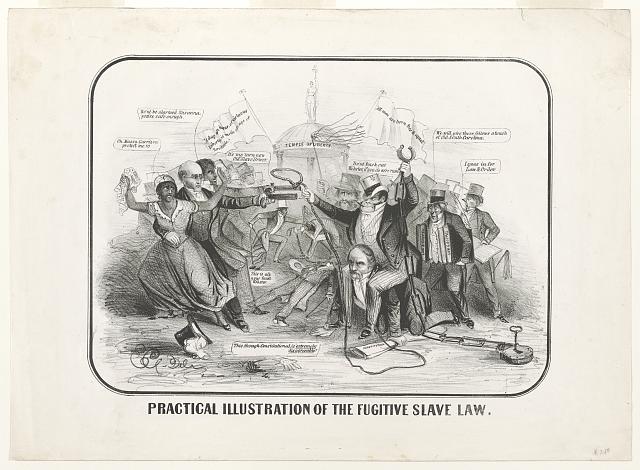
What Is the Fugitive Slave Act of 1850?
A federal law that required citizens to assist in the capture of escaped enslaved people and denied fugitives the right to a jury trial, inflaming tensions that led to the Civil War.
The Fugitive Slave Act of 1850 was one of the most controversial laws ever passed by the United States Congress. Signed into law on September 18, 1850, by President Millard Fillmore, it was part of a package of five laws called the Compromise of 1850, designed to ease tensions between Northern and Southern states over the question of slavery. Before this law, enslaved people who escaped to free Northern states had some measure of safety — most Northerners would not turn them in. The Fugitive Slave Act changed everything. It required all U.S. citizens, even those living in free states, to assist in capturing and returning escaped enslaved people to their enslavers. Federal marshals who refused to enforce the law faced heavy fines. Special commissioners were paid more to rule that a person was enslaved than to declare them free — creating a financial incentive to side against Black people. The law had a devastating impact. It made free Black people in Northern states vulnerable — they could be accused of being escaped slaves and had no right to testify in their own defense or request a jury trial. The law also had an unintended consequence: it radicalized thousands of Northerners who had previously been indifferent to slavery. When they were forced to participate in capturing human beings, many people who had stayed on the sidelines joined the abolitionist movement. The Fugitive Slave Act is considered one of the major steps toward the Civil War.
Historical Context
By 1850, the United States was deeply divided. New territories won from Mexico raised an urgent question: would slavery be allowed to expand westward? Southern states threatened to leave the Union if slavery was restricted. Northern states were growing increasingly uncomfortable with slavery but were not yet unified in opposing it. The Compromise of 1850 was a last-ditch effort to hold the country together. California was admitted as a free state (which the South opposed), and in exchange, the South received a much stronger Fugitive Slave Law. Senator John C. Calhoun of South Carolina had long argued — before his death on March 31, 1850 — that the federal government was not doing enough to protect the rights of enslavers to recover their human property. Though Calhoun did not live to see the act signed, his arguments shaped the final law. The 1850 act gave enslavers that protection — at enormous moral cost to the nation.
Key Excerpts
Important passages from this primary source, presented in kid-friendly language.
"...it shall be the duty of all marshals and deputy marshals to obey and execute all warrants and precepts issued under the provisions of this act, when to them directed; and should any marshal or deputy marshal refuse to receive such warrant...he shall, on conviction thereof, be fined in the sum of one thousand dollars."
What this means: This section forced federal law enforcement officers to participate in capturing escaped enslaved people. If they refused, they would be fined the equivalent of thousands of dollars today — making refusal extremely costly.
"...the certificate issued to the claimant upon the order from the commissioner...shall be conclusive of the right of the person or persons in whose favor granted, to remove such fugitive to the State or Territory from which he escaped."
What this means: This part of the law shows how little protection Black people had. A simple certificate from a commissioner was enough to forcibly remove a person — no jury, no full trial, no chance for the accused to speak in their own defense.
"...the claimant of such fugitive, his or her agent or attorney, is hereby authorized and empowered to seize or arrest such fugitive from service or labor..."
What this means: This section gave professional 'slave catchers' — and even private citizens — legal authority to seize people they claimed were escaped slaves. It turned ordinary people into potential agents of the slave system.
Vocabulary Spotlight
Key words and phrases from this primary source.
Fugitive
A person who has escaped or is running away from something, often from the law or captivity
Compromise
An agreement where both sides give up something they want in order to reach a deal
Federal Marshal
A law enforcement officer who works for the United States federal government, not for a state or local government
Abolitionist
A person who believed slavery should be completely ended — abolished
Commissioner
An official appointed to carry out specific government duties
Jurisdiction
The authority or right of a legal body to make and enforce laws in a certain area
Testimony
A formal statement, especially one given in a court of law
Underground Railroad
A network of secret routes, safe houses, and brave people who helped enslaved people escape to freedom in the North or Canada
Impact & Legacy
Watch and Learn
Did You Know?
Commissioners Were Paid More to Rule Against Black People
Under the law, a commissioner received $10 if they ruled a person was an escaped slave (returning them to slavery), but only $5 if they ruled the person was free. This financial incentive was built directly into the law.
Free Black People Could Be Kidnapped
Free Black citizens in the North — people who had never been enslaved — could be accused of being escaped slaves. Without the right to testify in their own defense, some free people were wrongly returned to slavery.
It Backfired on the South
The Fugitive Slave Act actually hurt the pro-slavery cause. Thousands of previously neutral Northerners became abolitionists after seeing people captured in their towns and dragged south in chains.
Harriet Tubman Extended Her Routes to Canada
After the law passed, free states were no longer safe for escaped enslaved people. Tubman rerouted the Underground Railroad all the way to Ontario, Canada — where U.S. law could not reach.
Some Northern States Refused to Enforce It
Several Northern states passed 'Personal Liberty Laws' to resist the Fugitive Slave Act. They prohibited state officials from helping to capture escaped enslaved people — a form of direct defiance.
It Was One Spark That Lit the Civil War
Historians consider the Fugitive Slave Act one of the key events on the path to the Civil War. By forcing Northerners to participate in slavery, it made compromise on the issue nearly impossible.
Related Events
Landmark events connected to this primary source.
Related Primary Sources
Other important documents and speeches in Black history.
Want to teach this primary source? We've done the work for you.
Fugitive Slave Act of 1850 Complete Teaching Bundle
Lesson Plan
Comprehensive lesson plan covering the document's background, key passages, author's purpose, and historical impact.
Student Workbook
Interactive workbook with source analysis exercises, reading comprehension, vocabulary in context, and compare & contrast activities.
Flashcard Set
40 cards covering vocabulary, key excerpts, historical context, author's purpose, and review challenges.
Instant digital download · Printable PDF · Grades 4–8 · Verified accurate
Here's a peek inside...
📖 Lesson Plan
📝 Student Workbook
Read the excerpt from Fugitive Slave Act of 1850 and answer the questions below.
🃏 Flashcard Set - Click to Flip!
Click the card to flip it
Get a Free Sample
Try before you buy! Enter your email to receive a free sampler with flashcards, activities, and a lesson plan excerpt. No spam, just history.