Dred Scott v. Sandford Decision
By U.S. Supreme Court
The Supreme Court ruled that Black people were not citizens and had no rights, a decision so unjust that it helped push the nation toward the Civil War.
View Teaching Bundle →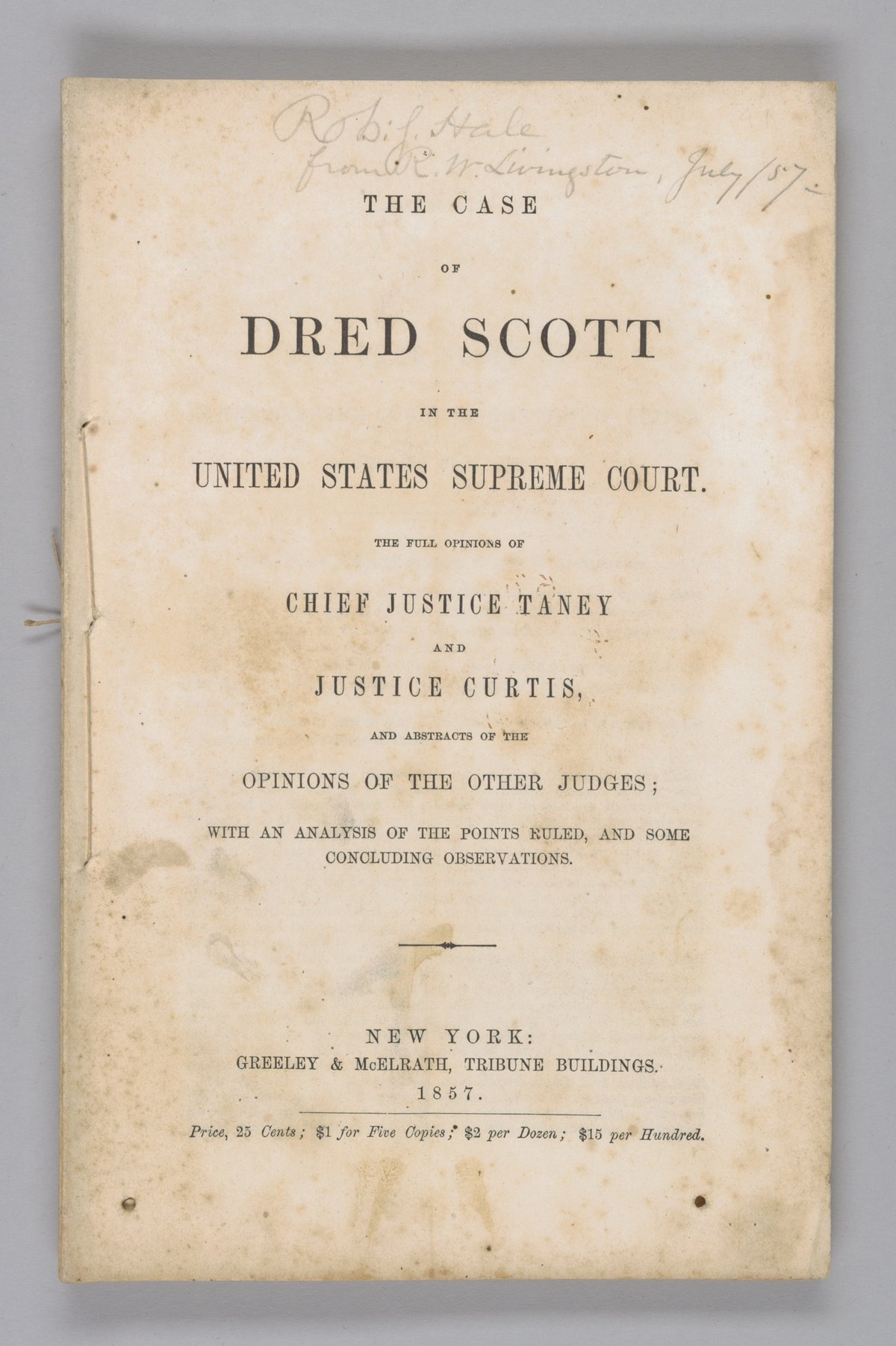
What Is the Dred Scott v. Sandford Decision?
The Supreme Court ruled that Black people were not citizens and had no rights, a decision so unjust that it helped push the nation toward the Civil War.
On March 6, 1857, the United States Supreme Court issued one of the most consequential and most condemned decisions in American legal history. In a 7-2 ruling, Chief Justice Roger B. Taney declared that Dred Scott, an enslaved man who had sued for his freedom, was not a citizen and had no right to bring a case before the courts at all. Dred Scott had been enslaved by Dr. John Emerson of Missouri. When Emerson moved to Illinois (a free state) and then to the Wisconsin Territory — land that is now part of Minnesota — Scott went with him. After returning to Missouri, Scott sued for his freedom, arguing that his years of living in free territory had made him legally free. Lower courts had gone back and forth on his case for over a decade. Chief Justice Taney's majority opinion went far beyond Dred Scott's individual case. He wrote that Black people — enslaved or free — 'had no rights which the white man was bound to respect' and were not citizens of the United States. He also declared the Missouri Compromise (which had banned slavery from northern territories since 1820) unconstitutional, ruling that Congress could never ban slavery from any territory. The decision was a catastrophe for the antislavery movement. It meant that no matter how long an enslaved person lived in a free state, they could not claim freedom. It meant that slavery could spread into any territory. It outraged abolitionists across the North, turned moderate opponents of slavery into fierce ones, and is widely considered one of the causes of the Civil War. The 14th Amendment, ratified in 1868, directly overturned the Dred Scott decision by granting citizenship to all persons born in the United States.
Historical Context
By the 1850s, the United States was tearing itself apart over slavery. New territories were being settled in the West, and the central question was always: will slavery be permitted here? The Missouri Compromise of 1820 had drawn a line — slavery would be permitted south of it and banned north of it in new territories. This fragile agreement had held the peace for nearly 40 years. The Dred Scott case arrived at the Supreme Court at the worst possible moment. Tensions were already high after the Fugitive Slave Act of 1850 and the Kansas-Nebraska Act of 1854, which had reopened the question of slavery in new territories and led to violent conflict in Kansas. Chief Justice Taney believed a sweeping ruling would settle the slavery question once and for all. Instead, it accelerated the nation's descent into civil war.
Key Excerpts
Important passages from this primary source, presented in kid-friendly language.
"They had for more than a century before been regarded as beings of an inferior order, and altogether unfit to associate with the white race, either in social or political relations; and so far inferior, that they had no rights which the white man was bound to respect."
What this means: This is one of the most infamous sentences in American legal history. Chief Justice Taney is describing how Black people were viewed at the time of the Founding — and using that historical view to argue they could never be citizens. This is not a description of how things should be; it was used to justify denying Dred Scott his day in court.
"A free negro of the African race, whose ancestors were brought to this country and sold as slaves, is not a 'citizen' within the meaning of the Constitution of the United States."
What this means: Taney ruled that no Black person — not even free Black people whose families had lived in America for generations — could be a U.S. citizen. This one sentence stripped citizenship from every Black person in America.
"An act of Congress which deprives a citizen of his liberty or property, merely because he came himself or brought his property into a particular Territory of the United States...could hardly be dignified with the name of due process of law."
What this means: This section declared the Missouri Compromise unconstitutional. Taney argued that Congress could not ban enslaved people (who were classified as property) from any territory — because that would deprive enslavers of their 'property' without due process.
Vocabulary Spotlight
Key words and phrases from this primary source.
Plaintiff
The person who brings a case to court — the person suing
Defendant
The person being sued or accused in a legal case
Jurisdiction
A court's legal authority to hear a particular kind of case
Unconstitutional
Not permitted by the Constitution; in conflict with what the Constitution says or allows
Due Process
The legal principle that the government must follow fair procedures before taking away a person's life, liberty, or property
Missouri Compromise
An 1820 agreement that admitted Missouri as a slave state and Maine as a free state, and drew a line dividing free and slave territories
Dissent
A written disagreement from judges who voted against the majority in a court case
Precedent
A court decision that serves as an example or guide for future cases
Impact & Legacy
Watch and Learn
Did You Know?
The Case Name Has a Spelling Error
The case is officially Dred Scott v. Sandford — but the defendant's name was actually John Sanford. A court clerk misspelled it, and the error was never corrected. The misspelling is now permanently embedded in history.
The Entire Scott Family Was Freed Months After Losing the Case
Despite losing in the Supreme Court, Dred Scott, his wife Harriet, and their two daughters Eliza and Lizzie were all emancipated in May 1857 — just months after the ruling. Their new owner freed them. Tragically, Dred Scott died of tuberculosis on September 17, 1858, just over a year after gaining his freedom.
Two Justices Stood Against the Ruling
Justices John McLean and Benjamin Curtis issued powerful dissenting opinions, arguing that free Black people had been citizens in many states at the time of the Founding. Their dissents became important arguments used by abolitionists.
The Decision Outraged Even Moderate Anti-Slavery Northerners
Many Northerners who had been willing to accept slavery where it existed were not willing to accept its spread into all territories. The Dred Scott decision eliminated the compromise position — you were either pro-slavery or against it.
Frederick Douglass Called It a Profound Injustice — and Predicted Its Defeat
Douglass expressed outrage at the decision but also expressed unexpected faith: he believed the very injustice of the ruling would accelerate the end of slavery. He was right — the Civil War began four years later.
It Helped Abraham Lincoln Win the Presidency
The Dred Scott decision became a major issue in the 1858 Illinois Senate race between Abraham Lincoln and Stephen Douglas. Lincoln's arguments against the ruling gained him national attention and helped propel him to the presidency in 1860.
Related Events
Landmark events connected to this primary source.
January 1, 1863
Emancipation Proclamation
President Abraham Lincoln issued an executive order declaring enslaved people in Confederate states to be forever free, transforming the Civil War into a fight for human freedom.
December 6, 1865
Ratification of the 13th Amendment
The 13th Amendment to the U.S. Constitution was ratified, permanently abolishing slavery throughout the United States and ending centuries of forced labor.
Related Primary Sources
Other important documents and speeches in Black history.
September 18, 1850 · Legislation
Fugitive Slave Act of 1850
A federal law that required citizens to assist in the capture of escaped enslaved people and denied fugitives the right to a jury trial, inflaming tensions that led to the Civil War.
December 6, 1865 · Constitutional Amendment
13th Amendment to the Constitution
The constitutional amendment that permanently abolished slavery in the United States, declaring that 'neither slavery nor involuntary servitude' shall exist within the nation.
Want to teach this primary source? We've done the work for you.
Dred Scott v. Sandford Decision Complete Teaching Bundle
Lesson Plan
Comprehensive lesson plan covering the document's background, key passages, author's purpose, and historical impact.
Student Workbook
Interactive workbook with source analysis exercises, reading comprehension, vocabulary in context, and compare & contrast activities.
Flashcard Set
40 cards covering vocabulary, key excerpts, historical context, author's purpose, and review challenges.
Instant digital download · Printable PDF · Grades 4–8 · Verified accurate
Here's a peek inside...
📖 Lesson Plan
📝 Student Workbook
Read the excerpt from Dred Scott v. Sandford Decision and answer the questions below.
🃏 Flashcard Set - Click to Flip!
Click the card to flip it
Get a Free Sample
Try before you buy! Enter your email to receive a free sampler with flashcards, activities, and a lesson plan excerpt. No spam, just history.