13th Amendment to the Constitution
By U.S. Congress
The constitutional amendment that permanently abolished slavery in the United States, declaring that 'neither slavery nor involuntary servitude' shall exist within the nation.
View Teaching Bundle →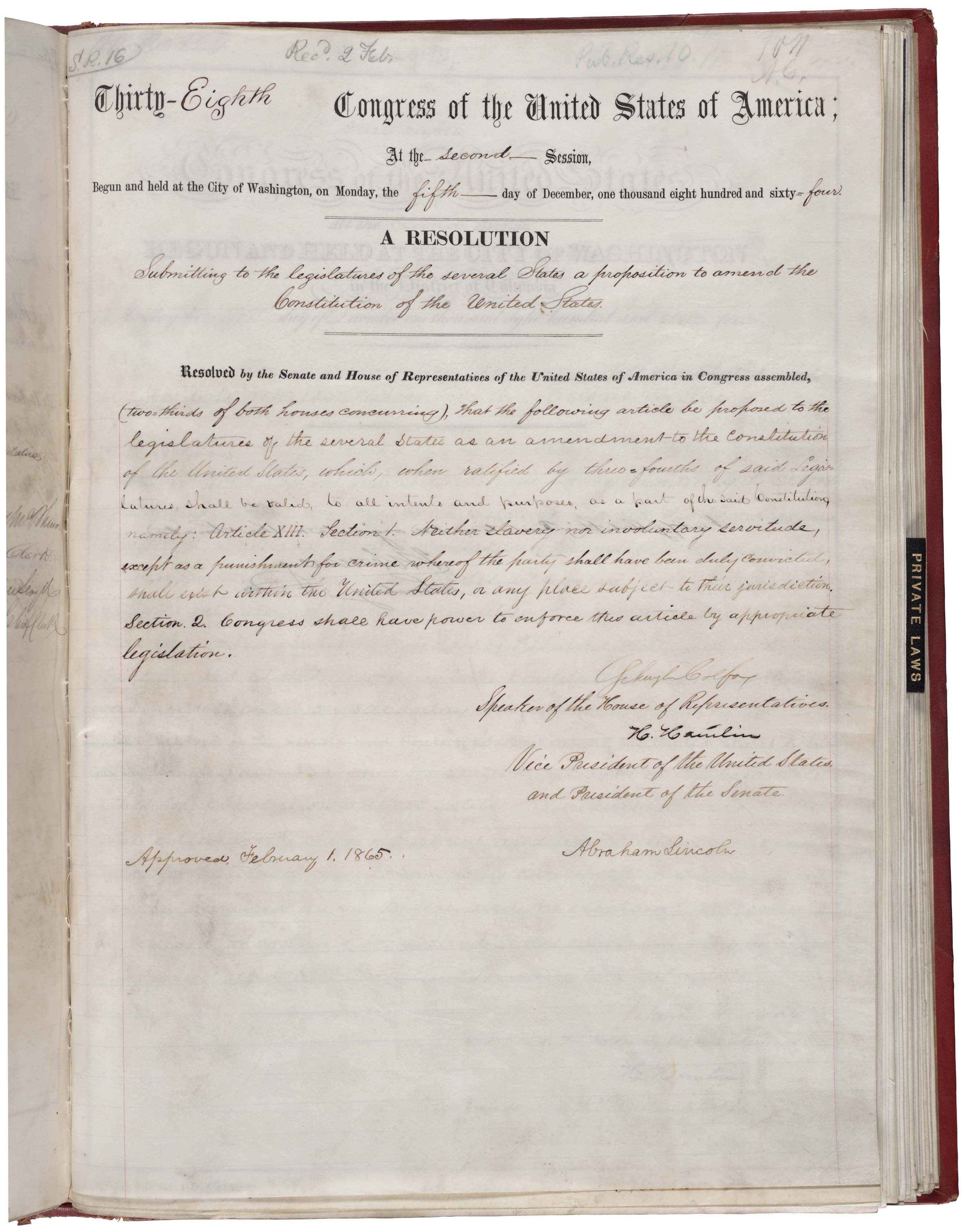
What Is the 13th Amendment to the Constitution?
The constitutional amendment that permanently abolished slavery in the United States, declaring that 'neither slavery nor involuntary servitude' shall exist within the nation.
The 13th Amendment to the United States Constitution is one of the most powerful documents in American history. Ratified on December 6, 1865, it permanently abolished slavery throughout the entire country. For the first time, the law of the land declared that no person could be owned by another — a promise that millions of enslaved Black Americans had fought, prayed, and sacrificed for across generations. With just two short sentences, the amendment changed the meaning of freedom in America forever. Before the 13th Amendment, slavery had existed in America for more than 200 years. Millions of Black men, women, and children were bought and sold as property, forced to labor without pay, and denied basic human rights. The Emancipation Proclamation, issued by President Abraham Lincoln in 1863, had declared enslaved people in Confederate states free — but it was an executive order, not a law, and it did not cover all enslaved people in every state. The 13th Amendment went further. It did not just free people in some states — it ended slavery everywhere in the United States, permanently and constitutionally. The road to ratification was not easy. The amendment passed the U.S. Senate in April 1864, but it failed in the House of Representatives that summer. President Lincoln pushed hard for a second vote, personally lobbying lawmakers. On January 31, 1865, the House passed the amendment 119 to 56. People in the gallery wept with joy. For the first time, Black spectators were allowed to watch from the gallery of the House chamber — and they were there to witness the vote that would change their world. Sadly, Lincoln was assassinated on April 14, 1865 — before the amendment was officially ratified. He did not live to see the final completion of the work he had championed. On December 6, 1865, the required number of states ratified the 13th Amendment, and it became part of the Constitution. The 4 million people who had been enslaved in America were legally free. It was a turning point in American history — and one of the greatest achievements of the abolitionist movement that Black leaders, writers, and freedom fighters had built over decades.
Historical Context
By the 1860s, the United States was deeply divided over the issue of slavery. The Southern states had built their economy on the labor of enslaved Black people, and they fought fiercely to protect that system. The Northern states were increasingly opposed to the expansion of slavery, and the conflict finally exploded into the Civil War in April 1861. It became the deadliest war in American history, with more than 600,000 soldiers killed. At its heart, the war was a battle over whether slavery would continue to exist in America. Black Americans did not wait passively for freedom to come. Abolitionists like Frederick Douglass, Sojourner Truth, and Harriet Tubman had spent decades speaking, writing, organizing, and risking their lives to fight slavery. Enslaved people resisted in countless ways — through escape, community, and determination. When the Civil War began, nearly 180,000 Black men enlisted in the Union Army and fought for freedom with extraordinary courage. Their sacrifice helped turn the tide of the war and made the case that Black Americans deserved full citizenship and freedom. After the war ended in April 1865, the nation faced the enormous challenge of Reconstruction — rebuilding the South and determining the legal status of 4 million formerly enslaved people. The 13th Amendment was the first of three Reconstruction amendments (alongside the 14th and 15th) that tried to redefine American democracy after slavery. Together, these amendments attempted to create a new America built on equality — though the full promise of that equality would remain a struggle for generations to come.
Key Excerpts
Important passages from this primary source, presented in kid-friendly language.
"Neither slavery nor involuntary servitude, except as a punishment for crime whereof the party shall have been duly convicted, shall exist within the United States, or any place subject to their jurisdiction."
What this means: This is Section 1 of the 13th Amendment — the most important sentence. In plain language, it means: slavery is permanently illegal in the United States. The phrase 'involuntary servitude' means being forced to work against your will. The one exception mentioned is people who have been convicted of a crime. This exception has been the subject of debate among civil rights scholars, since it has sometimes been used to justify prison labor.
"Congress shall have power to enforce this article by appropriate legislation."
What this means: This is Section 2, the enforcement clause. It means that Congress — the lawmaking branch of the United States government — has the authority to pass laws that make sure the abolition of slavery is upheld. This gave Congress the power to protect the rights of formerly enslaved people and penalize anyone who tried to re-enslave them.
"shall exist within the United States, or any place subject to their jurisdiction."
What this means: The phrase 'any place subject to their jurisdiction' is important because it meant the amendment applied not just to states but to U.S. territories and any other land under American control. There would be no loopholes — no corner of the country where slavery could legally survive.
Vocabulary Spotlight
Key words and phrases from this primary source.
Abolition
The act of officially ending or banning something — in this case, slavery
Involuntary servitude
Being forced to work for someone against your will, without freedom to leave or refuse
Ratification
The official process of formally approving a law or amendment so it becomes binding
Constitutional amendment
An official change or addition to the United States Constitution, the nation's highest law
Jurisdiction
The official power or authority a government has over a particular area or group of people
Emancipation
The act of being set free, especially from legal, social, or political restrictions
Abolitionist
A person who worked to end slavery through speaking, writing, organizing, and legal action
Reconstruction
The period after the Civil War (1865–1877) when the country worked to rebuild and redefine itself, including the legal status of formerly enslaved people
Impact & Legacy
Watch and Learn
Did You Know?
The Vote That Made People Weep
When the House of Representatives passed the 13th Amendment on January 31, 1865, the chamber erupted in celebration. Spectators in the gallery shouted and wept. Outside the Capitol, crowds cheered and cannons were fired in celebration. It was one of the most emotional moments in congressional history.
The Emancipation Proclamation Was Not Enough
Many people think the Emancipation Proclamation ended slavery — but it only applied to Confederate states that were in rebellion. It did not apply to border states still in the Union that permitted slavery, like Kentucky and Delaware. The 13th Amendment closed that gap and ended slavery everywhere, permanently.
Lincoln Didn't Live to See It
President Abraham Lincoln was assassinated on April 14, 1865 — eight months before the 13th Amendment was officially ratified on December 6, 1865. He fought harder than almost anyone to get the amendment passed, but he never witnessed the final, legal end of slavery in America.
Mississippi Waited 130 Years
Mississippi did not ratify the 13th Amendment until 1995 — and due to a paperwork error, the ratification was not officially recorded by the federal government until 2013. A professor discovered the oversight after watching the film Lincoln, which prompted officials to correct the record.
The Prison Labor Exception
The 13th Amendment contains an exception: it allows involuntary servitude 'as a punishment for crime.' After the Civil War, some Southern states used this clause to arrest Black men on minor or false charges and force them to labor — a system called convict leasing. Civil rights scholars have studied and critiqued this loophole for more than a century.
Related Events
Landmark events connected to this primary source.
Related Primary Sources
Other important documents and speeches in Black history.
July 9, 1868 · Constitutional Amendment
14th Amendment to the Constitution
The amendment that granted citizenship to all persons born in the United States and guaranteed equal protection under the law, becoming the foundation for civil rights litigation.
February 3, 1870 · Constitutional Amendment
15th Amendment to the Constitution
The amendment that prohibited denying the right to vote based on race, color, or previous condition of servitude, though enforcement would take another century of struggle.
Want to teach this primary source? We've done the work for you.
13th Amendment to the Constitution Complete Teaching Bundle
Lesson Plan
Comprehensive lesson plan covering the document's background, key passages, author's purpose, and historical impact.
Student Workbook
Interactive workbook with source analysis exercises, reading comprehension, vocabulary in context, and compare & contrast activities.
Flashcard Set
40 cards covering vocabulary, key excerpts, historical context, author's purpose, and review challenges.
Instant digital download · Printable PDF · Grades 4–8 · Verified accurate
Here's a peek inside...
📖 Lesson Plan
📝 Student Workbook
Read the excerpt from 13th Amendment to the Constitution and answer the questions below.
🃏 Flashcard Set - Click to Flip!
Click the card to flip it
Get a Free Sample
Try before you buy! Enter your email to receive a free sampler with flashcards, activities, and a lesson plan excerpt. No spam, just history.