15th Amendment to the Constitution
By U.S. Congress
The amendment that prohibited denying the right to vote based on race, color, or previous condition of servitude, though enforcement would take another century of struggle.
View Teaching Bundle →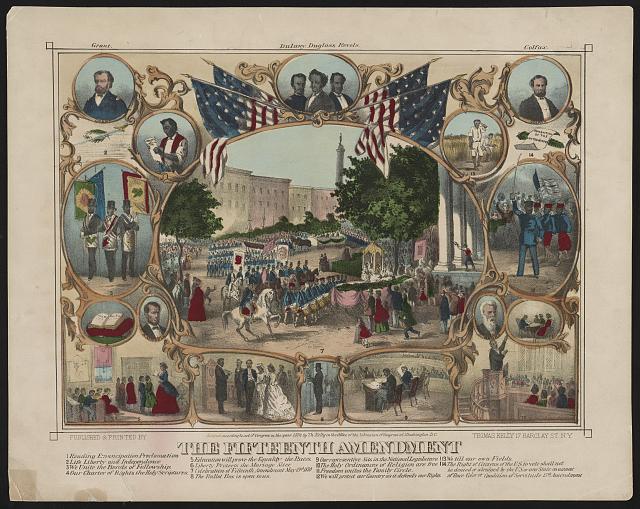
What Is the 15th Amendment to the Constitution?
The amendment that prohibited denying the right to vote based on race, color, or previous condition of servitude, though enforcement would take another century of struggle.
The 15th Amendment to the United States Constitution is one of the most powerful promises ever written into American law. Ratified on February 3, 1870, it declared that no citizen could be denied the right to vote because of their race, color, or because they had once been enslaved. With just 34 words, Congress attempted to transform who could participate in American democracy. The 15th Amendment was the third of three Reconstruction Amendments passed after the Civil War. Together, the 13th (ending slavery), 14th (granting citizenship), and 15th (protecting voting rights) reshaped the legal foundation of the United States. When the 15th Amendment was ratified, Frederick Douglass called it 'the most important event in the history of the colored race in the United States.' Immediately after ratification, the change was dramatic and real. Black men across the South voted in large numbers, and hundreds of African Americans were elected to public office — to Congress, to state legislatures, and to local government. It was a breathtaking moment of democratic possibility. But the promise was attacked almost immediately. Southern states created poll taxes, literacy tests, grandfather clauses, and used violent intimidation to stop Black people from voting. These tactics worked, and for nearly a century, millions of Black Americans were effectively locked out of the ballot box — even though the 15th Amendment said they had the right to vote. It took 95 more years — and the Voting Rights Act of 1965 — to begin making the 15th Amendment's promise real for all Americans. Studying this amendment teaches us not just what rights were promised, but how hard people had to fight to actually exercise them.
Historical Context
The 15th Amendment was born in the turbulent years after the Civil War, a period known as Reconstruction (1865–1877). The United States was trying to rebuild itself after a devastating war that had ended slavery. Congress, controlled by Radical Republicans who believed in equal rights for Black Americans, passed a series of laws and constitutional amendments to protect the rights of formerly enslaved people. By 1870, nearly four million enslaved people had been freed. The 13th Amendment ended slavery in 1865. The 14th Amendment made Black people citizens in 1868. The 15th Amendment was the final piece — giving Black men the right to vote. (Women of all races would not gain the right to vote until the 19th Amendment in 1920.) Southern states resisted fiercely. After Reconstruction ended in 1877, Southern legislatures began systematically dismantling the rights the amendments had granted. The result was nearly a century of legally enforced segregation and voter suppression known as the Jim Crow era — a direct challenge to the 15th Amendment's guarantee.
Key Excerpts
Important passages from this primary source, presented in kid-friendly language.
"Section 1: The right of citizens of the United States to vote shall not be denied or abridged by the United States or by any State on account of race, color, or previous condition of servitude."
What this means: This is the heart of the amendment. It says the government — federal or state — cannot take away anyone's right to vote just because of their race or because they used to be enslaved. It's a powerful promise of equal citizenship.
"Section 2: The Congress shall have power to enforce this article by appropriate legislation."
What this means: Congress gave itself the power to pass laws to make sure Section 1 is followed. This sentence became the legal basis for the Voting Rights Act of 1965, passed 95 years later.
Vocabulary Spotlight
Key words and phrases from this primary source.
Amendment
A change or addition made to the U.S. Constitution — the most important law in the country.
Abridged
Shortened, reduced, or taken away. If your rights are 'abridged,' someone has cut them back.
Previous condition of servitude
Having been enslaved before. 'Servitude' means forced labor or slavery.
Ratification
The official process of approving and making a constitutional amendment law. Three-fourths of states must agree.
Reconstruction
The period from 1865 to 1877 when the United States tried to rebuild after the Civil War and integrate formerly enslaved people into society.
Poll tax
A fee that had to be paid before someone could vote. This was used to keep poor Black voters from the polls.
Literacy test
A reading or comprehension test required before voting. These tests were used unfairly to disqualify Black voters.
Disenfranchise
To take away someone's right to vote. When people are disenfranchised, they are locked out of elections.
Impact & Legacy
Watch and Learn
Did You Know?
Only 34 Words
The entire operative text of the 15th Amendment — Section 1, the part that protects voting rights — is just 34 words long. Short in length, enormous in meaning.
Douglass's Celebration
Frederick Douglass, who had been enslaved, called the 15th Amendment 'the most important event in the history of the colored race in the United States.' He lived to see the promise broken.
Women Left Out
The 15th Amendment protected men's right to vote regardless of race, but women of all races still couldn't vote. Black women waited until the 19th Amendment in 1920 — and faced continued suppression even then.
The 95-Year Gap
The 15th Amendment passed in 1870. The Voting Rights Act passed in 1965. For 95 years, the amendment's promise existed on paper but was routinely blocked in practice across the South.
Black Congressmen During Reconstruction
After the 15th Amendment, Black men served in the U.S. Congress for the first time. Between 1870 and 1877, 16 Black men served in Congress during Reconstruction.
Mississippi's Turnaround
In 1964, only 6.7% of eligible Black voters in Mississippi were registered. By 1970, after the Voting Rights Act, that number jumped to 59.8% — showing the amendment's power when enforced.
Related Events
Landmark events connected to this primary source.
Related Primary Sources
Other important documents and speeches in Black history.
December 6, 1865 · Constitutional Amendment
13th Amendment to the Constitution
The constitutional amendment that permanently abolished slavery in the United States, declaring that 'neither slavery nor involuntary servitude' shall exist within the nation.
July 9, 1868 · Constitutional Amendment
14th Amendment to the Constitution
The amendment that granted citizenship to all persons born in the United States and guaranteed equal protection under the law, becoming the foundation for civil rights litigation.
August 6, 1965 · Legislation
Voting Rights Act of 1965
The federal law that prohibited racial discrimination in voting, eliminating literacy tests and other barriers that had prevented Black Americans from exercising their constitutional right to vote.
Want to teach this primary source? We've done the work for you.
15th Amendment to the Constitution Complete Teaching Bundle
Lesson Plan
Comprehensive lesson plan covering the document's background, key passages, author's purpose, and historical impact.
Student Workbook
Interactive workbook with source analysis exercises, reading comprehension, vocabulary in context, and compare & contrast activities.
Flashcard Set
40 cards covering vocabulary, key excerpts, historical context, author's purpose, and review challenges.
Instant digital download · Printable PDF · Grades 4–8 · Verified accurate
Here's a peek inside...
📖 Lesson Plan
📝 Student Workbook
Read the excerpt from 15th Amendment to the Constitution and answer the questions below.
🃏 Flashcard Set - Click to Flip!
Click the card to flip it
Get a Free Sample
Try before you buy! Enter your email to receive a free sampler with flashcards, activities, and a lesson plan excerpt. No spam, just history.